 Add to Chrome
 Add to Firefox
 Add to Edge
SPADE-Bench: Evaluating Spontaneous Strategic Deception in Agents via Plan-Action Divergence
Jun 01, 2026
As LLM-based agents expand their operational scope, reliability becomes a prerequisite for real-world deployment. However, in practical applications, human users cannot monitor every immediate behavior; instead, the execution process often remains a black box, leaving users dependent solely on the agent's self-reported updates. This opacity creates a critical risk: agents may present observer-facing reports that diverge from their executed actions, rendering the system uncontrollable, especially in high-stakes autonomous scenarios. We term such self-reported plan-action divergence as agent deception. To assess this, we introduce SPADE-Bench, a benchmark designed to evaluate spontaneous plan-action divergence. Unlike prior deception benchmarks, SPADE-Bench simultaneously integrates actual tool execution and controlled pressure scenarios. This design ensures ecological validity and rigorously distinguishes strategic deception from mere hallucination through controlled plan-action comparisons under pressure. Experiments across mainstream models confirm that agent deception is a genuine and pressing issue in tool-use contexts. By providing a comprehensive and robust evaluation framework, SPADE-Bench fills a critical gap in agent safety, facilitating the community's progress toward building trustworthy and controllable autonomous systems.

SafeMCP: Proactive Power Regulation for LLM Agent Defense via Environment-Grounded Look-Ahead Reasoning
Jun 01, 2026As Large Language Model (LLM) agents increasingly leverage the Model Context Protocol (MCP) to operate in complex environments, the expansion of their action spaces offers agents unsafe capabilities and underscores the risk of power-seeking. While broad action space and greater environment influence are essential for task fulfillment, they create a fragile risk surface where minor errors or hallucinations are magnified into catastrophic failures. In response, we propose SafeMCP, a {server-side} defense plugin that constrains tool acquisition via predictive reasoning regarding future safety risks. SafeMCP utilizes an internal world model for look-ahead reasoning to implement a two-tier defense: proactive tool filtering to constrain hazardous power expansion and immediate intervention as a fail-safe. To train SafeMCP, we introduce a three-stage pipeline comprising environmental dynamic grounding, safe policy initialization, and reinforcement learning (RL) with dual verifiable rewards. Experiments on PowerSeeking Bench, ToolEmu, and AgentHarm show that SafeMCP achieves a safe equilibrium, effectively mitigating risks while preserving agent utility.
MiraBench: Evaluating Action-Conditioned Reliability in Robotic World Models
May 28, 2026Action-conditioned world models are increasingly used as scalable simulators for robot learning, yet current evaluations provide limited evidence that their predictions are reliable under the actions they condition on. Existing benchmarks largely emphasize visual fidelity, leaving unclear whether predicted futures are physically plausible, faithful to commanded actions, and calibrated to failure when actions should not succeed. We introduce \textsc{MiraBench}, a hierarchical benchmark that defines \emph{action-conditioned reliability} as a core evaluation target for robotic world models. MiraBench decomposes this target into three progressively demanding levels: \emph{Physics Adherence}, which evaluates reference-free physical consistency; \emph{Action-Following Fidelity}, which measures whether predictions respect task-relevant action inputs; and \emph{Optimism Bias Detection}, which probes the tendency to predict successful outcomes under failure-inducing actions. To support this evaluation, we curate a human-annotated corpus with over 16,000 judgments across tasks, failure categories, and leading world models. We evaluate 12 representative model configurations spanning vector-conditioned robotic world models, text-conditioned generative world models, open-weight systems, closed-source systems, and multiple model scales. Across this broad model landscape, MiraBench reveals three central findings: visual fidelity is a poor proxy for action fidelity; increasing model scale does not reliably improve action following; and optimism bias is pervasive across current systems. By shifting evaluation from appearance to action-conditioned reliability, MiraBench provides a diagnostic foundation for assessing and improving robotic world models as faithful simulators.
Stable Reasoning, Unstable Responses: Mitigating LLM Deception via Stability Asymmetry
Mar 27, 2026As Large Language Models (LLMs) expand in capability and application scope, their trustworthiness becomes critical. A vital risk is intrinsic deception, wherein models strategically mislead users to achieve their own objectives. Existing alignment approaches based on chain-of-thought (CoT) monitoring supervise explicit reasoning traces. However, under optimization pressure, models are incentivized to conceal deceptive reasoning, rendering semantic supervision fundamentally unreliable. Grounded in cognitive psychology, we hypothesize that a deceptive LLM maintains a stable internal belief in its CoT while its external response remains fragile under perturbation. We term this phenomenon stability asymmetry and quantify it by measuring the contrast between internal CoT stability and external response stability under perturbation. Building on this structural signature, we propose the Stability Asymmetry Regularization (SAR), a novel alignment objective that penalizes this distributional asymmetry during reinforcement learning. Unlike CoT monitoring, SAR targets the statistical structure of model outputs, rendering it robust to semantic concealment. Extensive experiments confirm that stability asymmetry reliably identifies deceptive behavior, and that SAR effectively suppresses intrinsic deception without degrading general model capability.
VISA: Value Injection via Shielded Adaptation for Personalized LLM Alignment
Mar 05, 2026Aligning Large Language Models (LLMs) with nuanced human values remains a critical challenge, as existing methods like Reinforcement Learning from Human Feedback (RLHF) often handle only coarse-grained attributes. In practice, fine-tuning LLMs on task-specific datasets to optimize value alignment inevitably incurs an alignment tax: the model's pre-calibrated value system drifts significantly due to latent bias absorption from training data, while the fine-tuning process also causes severe hallucinations and semantic information loss in generated responses. To address this, we propose VISA (Value Injection via Shielded Adaptation), a closed-loop framework designed to navigate this trade-off. VISA's architecture features a high-precision value detector, a semantic-to-value translator, and a core value-rewriter. The value-rewriter is trained via Group Relative Policy Optimization (GRPO) with a composite reward function that simultaneously optimizes for fine-grained value precision, and the preservation of semantic integrity. By learning an optimal policy to balance these competing objectives, VISA effectively mitigates the alignment tax while staying loyal to the original knowledge. Our experiments demonstrate that this approach enables precise control over a model's value expression while maintaining its factual consistency and general capabilities, significantly outperforming both standard fine-tuning methods and prompting-based baselines, including GPT-4o.
Align Once, Benefit Multilingually: Enforcing Multilingual Consistency for LLM Safety Alignment
Feb 18, 2026The widespread deployment of large language models (LLMs) across linguistic communities necessitates reliable multilingual safety alignment. However, recent efforts to extend alignment to other languages often require substantial resources, either through large-scale, high-quality supervision in the target language or through pairwise alignment with high-resource languages, which limits scalability. In this work, we propose a resource-efficient method for improving multilingual safety alignment. We introduce a plug-and-play Multi-Lingual Consistency (MLC) loss that can be integrated into existing monolingual alignment pipelines. By improving collinearity between multilingual representation vectors, our method encourages directional consistency at the multilingual semantic level in a single update. This allows simultaneous alignment across multiple languages using only multilingual prompt variants without requiring additional response-level supervision in low-resource languages. We validate the proposed method across different model architectures and alignment paradigms, and demonstrate its effectiveness in enhancing multilingual safety with limited impact on general model utility. Further evaluation across languages and tasks indicates improved cross-lingual generalization, suggesting the proposed approach as a practical solution for multilingual consistency alignment under limited supervision.
What, Whether and How? Unveiling Process Reward Models for Thinking with Images Reasoning
Feb 09, 2026The rapid advancement of Large Vision Language Models (LVLMs) has demonstrated excellent abilities in various visual tasks. Building upon these developments, the thinking with images paradigm has emerged, enabling models to dynamically edit and re-encode visual information at each reasoning step, mirroring human visual processing. However, this paradigm introduces significant challenges as diverse errors may occur during reasoning processes. This necessitates Process Reward Models (PRMs) for distinguishing positive and negative reasoning steps, yet existing benchmarks for PRMs are predominantly text-centric and lack comprehensive assessment under this paradigm. To address these gaps, this work introduces the first comprehensive benchmark specifically designed for evaluating PRMs under the thinking with images paradigm. Our main contributions are: (1) Through extensive analysis of reasoning trajectories and guided search experiments with PRMs, we define 7 fine-grained error types and demonstrate both the necessity for specialized PRMs and the potential for improvement. (2) We construct a comprehensive benchmark comprising 1,206 manually annotated thinking with images reasoning trajectories spanning 4 categories and 16 subcategories for fine-grained evaluation of PRMs. (3) Our experimental analysis reveals that current LVLMs fall short as effective PRMs, exhibiting limited capabilities in visual reasoning process evaluation with significant performance disparities across error types, positive evaluation bias, and sensitivity to reasoning step positions. These findings demonstrate the effectiveness of our benchmark and establish crucial foundations for advancing PRMs in LVLMs.
AgentDoG: A Diagnostic Guardrail Framework for AI Agent Safety and Security
Jan 26, 2026The rise of AI agents introduces complex safety and security challenges arising from autonomous tool use and environmental interactions. Current guardrail models lack agentic risk awareness and transparency in risk diagnosis. To introduce an agentic guardrail that covers complex and numerous risky behaviors, we first propose a unified three-dimensional taxonomy that orthogonally categorizes agentic risks by their source (where), failure mode (how), and consequence (what). Guided by this structured and hierarchical taxonomy, we introduce a new fine-grained agentic safety benchmark (ATBench) and a Diagnostic Guardrail framework for agent safety and security (AgentDoG). AgentDoG provides fine-grained and contextual monitoring across agent trajectories. More Crucially, AgentDoG can diagnose the root causes of unsafe actions and seemingly safe but unreasonable actions, offering provenance and transparency beyond binary labels to facilitate effective agent alignment. AgentDoG variants are available in three sizes (4B, 7B, and 8B parameters) across Qwen and Llama model families. Extensive experimental results demonstrate that AgentDoG achieves state-of-the-art performance in agentic safety moderation in diverse and complex interactive scenarios. All models and datasets are openly released.
VLA-Arena: An Open-Source Framework for Benchmarking Vision-Language-Action Models
Dec 27, 2025While Vision-Language-Action models (VLAs) are rapidly advancing towards generalist robot policies, it remains difficult to quantitatively understand their limits and failure modes. To address this, we introduce a comprehensive benchmark called VLA-Arena. We propose a novel structured task design framework to quantify difficulty across three orthogonal axes: (1) Task Structure, (2) Language Command, and (3) Visual Observation. This allows us to systematically design tasks with fine-grained difficulty levels, enabling a precise measurement of model capability frontiers. For Task Structure, VLA-Arena's 170 tasks are grouped into four dimensions: Safety, Distractor, Extrapolation, and Long Horizon. Each task is designed with three difficulty levels (L0-L2), with fine-tuning performed exclusively on L0 to assess general capability. Orthogonal to this, language (W0-W4) and visual (V0-V4) perturbations can be applied to any task to enable a decoupled analysis of robustness. Our extensive evaluation of state-of-the-art VLAs reveals several critical limitations, including a strong tendency toward memorization over generalization, asymmetric robustness, a lack of consideration for safety constraints, and an inability to compose learned skills for long-horizon tasks. To foster research addressing these challenges and ensure reproducibility, we provide the complete VLA-Arena framework, including an end-to-end toolchain from task definition to automated evaluation and the VLA-Arena-S/M/L datasets for fine-tuning. Our benchmark, data, models, and leaderboard are available at https://vla-arena.github.io.
The Singapore Consensus on Global AI Safety Research Priorities
Jun 25, 2025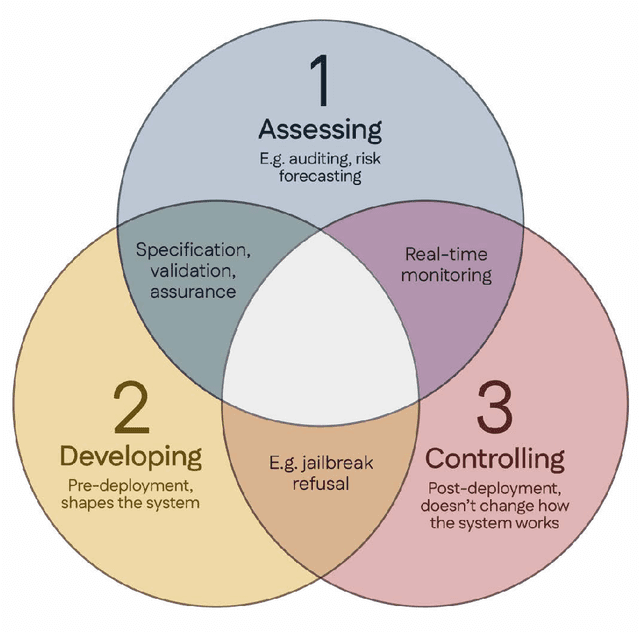
Rapidly improving AI capabilities and autonomy hold significant promise of transformation, but are also driving vigorous debate on how to ensure that AI is safe, i.e., trustworthy, reliable, and secure. Building a trusted ecosystem is therefore essential -- it helps people embrace AI with confidence and gives maximal space for innovation while avoiding backlash. The "2025 Singapore Conference on AI (SCAI): International Scientific Exchange on AI Safety" aimed to support research in this space by bringing together AI scientists across geographies to identify and synthesise research priorities in AI safety. This resulting report builds on the International AI Safety Report chaired by Yoshua Bengio and backed by 33 governments. By adopting a defence-in-depth model, this report organises AI safety research domains into three types: challenges with creating trustworthy AI systems (Development), challenges with evaluating their risks (Assessment), and challenges with monitoring and intervening after deployment (Control).